The Database Emptied Itself Twice: Forensics on Shared Credentials and Truncate-Capable Scripts
Twice in 2026 the TweakDeals database was emptied from under the site — in August, 2,544 products at 10:32 UTC were zero by 11:05. Forensics, guards, and the prebuild cache that saved the site.
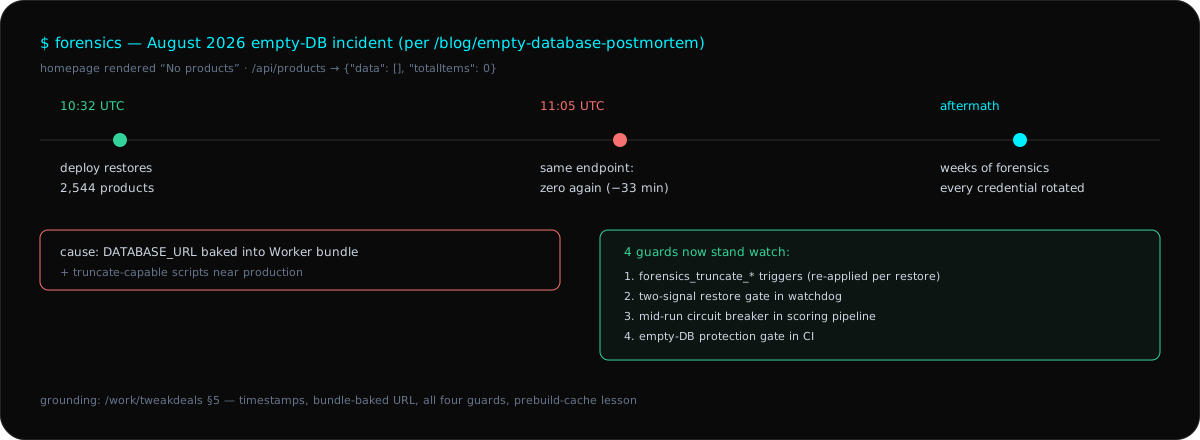
In August 2026 the deploy restored 2,544 products at 10:32 UTC. By 11:05 the same endpoint returned zero. The homepage rendered “No products” and /api/products returned:
{"data": [], "pagination": {"totalItems": 0}}Twice in 2026 the production database was emptied out from under the site. What follows is the forensics, the guards, and the architectural lesson, extracted from the TweakDeals case study.
The forensics
The investigation ran for weeks. Its findings, in order of embarrassment:
- A
DATABASE_URLbaked into a Worker bundle by a build script. Production credentials lived inside a shipped artifact. Every credential that had ever touched the box was rotated once this surfaced. - Truncate-capable scripts with a path to production.
forensics_truncate_*triggers were re-applied after every restore, which tells you what class of statement the estate had lying around. - No restore gate. Nothing stood between “database is empty” and “ship it”: the watchdog, the scoring pipeline, and CI all assumed a non-empty database rather than verifying one.
The guards
Four layers, each doing one job:
forensics_truncate_*triggers, re-applied after every restore (the database itself refuses the dangerous statement class).- A two-signal restore gate in the watchdog: restoration requires two independent confirmations, not one hopeful check.
- A mid-run circuit breaker in the scoring pipeline: a run that starts emptying things stops itself instead of completing the damage.
- An empty-DB protection gate in CI: any deploy landing with fewer products than expected is blocked before it ships. (The pipeline-side sibling of this thinking is the slim CI rebuild, where gates also learned to actually fail.)
The lesson that mattered
Public postmortems with transcripts are this site’s most distinctive asset. The 41-minute CSP outage and the prebuilt redirect saga already sit on the about shelf. This one extends the lineage to the most impressive live system: 2,084 products, 21 scheduled jobs, and a database that vanished twice without taking the site with it. The full system context is the TweakDeals case study.
Honest limitations
- Root cause, not root actor. The case documents the credential exposure and the truncate-capable scripts, not a named human-or-process culprit for either emptying. This postmortem claims the forensics, not an attribution.
- August timestamps are the only precise ones. The “twice in 2026” framing rests on the case body; only the August incident carries the 10:32/11:05 UTC timestamps quoted here.
- Credential rotation is described, not shown. Every credential was rotated; the rotation transcript is not part of the published record.
Related logs
The CSP Outage I Caused Myself: Placeholder Nonces, strict-dynamic, and Prebuilt Headers
A placeholder nonce that shipped to production took this site down for 41 minutes. Here is the exact failure, why static headers cannot emulate per-request nonces, and the three fixes that made the site both faster and actually secure.
RDS Certificate Subject-Name Mismatch: Binding Let's Encrypt Across All Four Roles
Twingate routed RDS traffic fine — then RD Gateway rejected every session on certificate subject-name mismatch. The fix: win-acme DNS-01 plus one PowerShell script binding all four RDS roles every 60 days.