18,000 Observations a Day: Inside the TweakDeals Price Pipeline
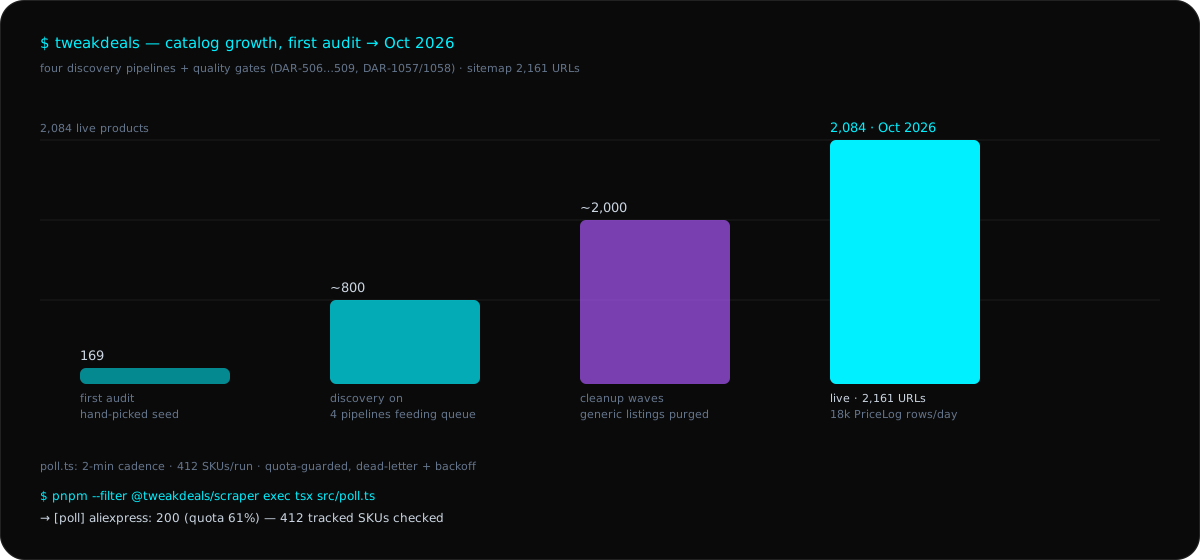
The case proves the what — 2,084 products, 21 jobs, 2-minute poll. This is the how: the quota-aware poll loop, the scoring curve that unclumped 55.8% at 75, and stale-by-design edge reads.
The TweakDeals case study proves the what: 2,084 live products, 21 scheduled jobs, a 2-minute poll interval, ~18,000 PriceLog observations a day. What follows is the mechanism behind those numbers: the poll loop, the scoring curve, and the stale-by-design reads, written for the reader with a catalog who wants to know whether the person behind it could instrument theirs.
The poll loop: quota-aware by construction
poll.ts runs on a two-minute cadence against the AliExpress affiliate API. The transcript in the case is the whole contract:
$ pnpm --filter @tweakdeals/scraper exec tsx src/poll.ts
[poll] aliexpress: 200 (quota 61%) — 412 tracked SKUs checked
[poll] 118 price changes · 9 new · 3 delisted
[poll] PriceLog rows written: 118   Transaction: ok
[poll] next run in 120s
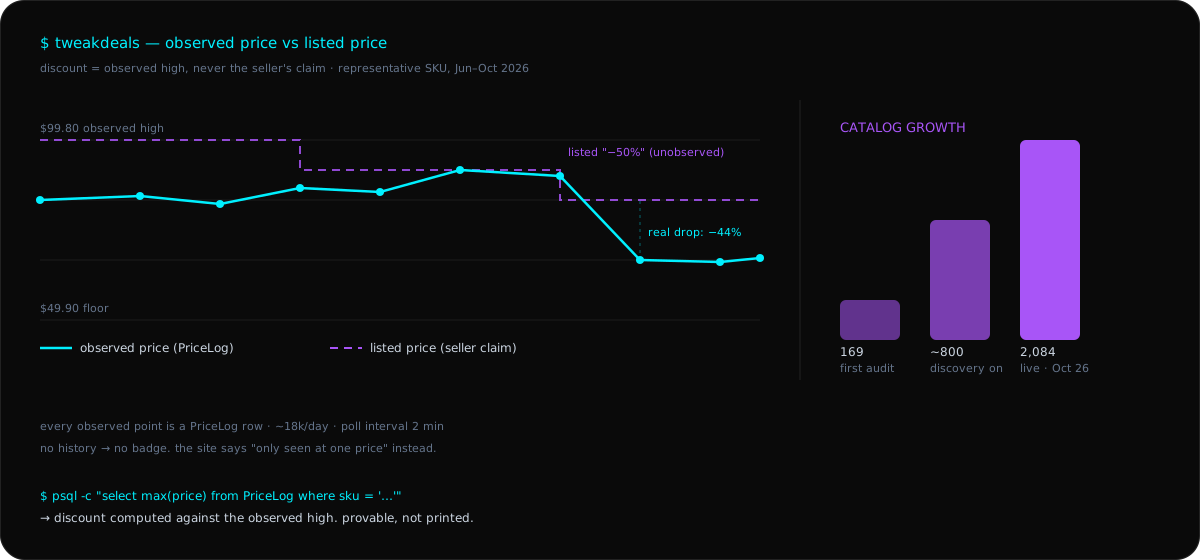
The expensive part isn’t the write: it’s the rate limit. The poller counts down remaining quota and logs a percentage on every run, and when a scrape fails it lands in the DeadLetterQueue with exponential backoff instead of throwing the batch away. At that rate the table takes on roughly 18,000 price observations a day:
$ psql $DATABASE_URL -c "select count(*) from \"PriceLog\" where observed_at > now() - interval '24 hours';"
 count
--------
 18422
That continuity is what makes the discount math defensible: every displayed discount is computed against the highest observed price, never the seller’s claim. A product seen at one price carries no badge (“no history” instead of an invented 50% off). Discovery grows the catalog the same unattended way: discover-from-reviews.ts mines competitor review pages, run-hotproduct-discovery.ts chases trending windows, find-affiliate-alternatives.ts links delisted products to live replacements. Quality gates sharpened across cleanup waves (DAR-506 through DAR-509, DAR-1057, DAR-1058) taught the pipeline to reject generic listings and miscategorized items.
The scoring curve: unclumping 75
Two LLM passes enrich the pipeline: one writes a two-sentence description, the other a clean displayTitle, because marketplace titles are keyword payloads, not headings. (That normalization ran across ~2,000 products and had to be re-run twice after a brand-truncation regex chopped names mid-word. Twice.)
The scorer produces a 0–100 qualityScore and dealScore from price history, review volume, and expert review coverage. Early calibration had a serious problem, quoted verbatim from the case: 55.8% of products landed at exactly 75, which meant the leaderboard was useless. Recalibrating the curve fixed the homogenization.
The lesson generalizes beyond deal sites: any scoring pipeline needs a distribution check, not just a correctness check. Every product scored “correctly” per the formula and the ranking was still meaningless — the output to monitor is the histogram, not the row. Watch the histogram.
Stale by design: the delivery split
The catalog is large, the pages are SEO-critical, and the source of truth has taken unplanned downtime more than once. That combination argues for the split the case documents:
- At build time,
prebuild-data.tspulls the catalog from Neon into a ~14 MB cache JSON (~2,200 products). If the database is unreachable, the build falls back to a committed cache snapshot instead of failing. - At request time, the Cloudflare Worker serves static assets from the edge. No SSR database call on the hot path.
- In the browser,
/api/pricing/[sku]hydrates live prices after first paint, and the freshness contract is explicit: the API reportsfreshnessMinutes, the UI shows it, and the nightlyprice-staleness-monitorfails the build past the window. A stale price that looks live is worse than an obviously old one.
The Neon Postgres note documents the storage split behind it: Prisma migrations in Node, raw SQL over HTTP from the edge. And the payoff is the case’s architectural lesson, quoted whole: the committed prebuild cache is not a fallback, it’s a durability guarantee — every 2026 database incident degraded the site to “prices a few hours stale” instead of a blank homepage. The empty-database postmortem is the forensics companion.
Honest limitations
- The scoring formula is described, not published. Inputs (price history, review volume, expert coverage) and the recalibration story are on the record; the weights aren’t. Treat the curve discussion as calibration discipline, not a reproducible recipe.
- Affiliate-API-shaped. The quota-aware degradation assumes a throttling upstream with a countable quota: poll loops against unmetered sources have a different failure mode (freshness, not budget).
- Free-tier economics throughout. The whole stack runs on free and launch tiers per the case, which constrains the design (static-first because incidents can’t be bought away) and bounds the transferability to catalogs that can afford otherwise.
If you run a catalog
If your catalog runs on seller-claimed discounts, observed history is the only correction I trust, and stale-by-design delivery is what turned every 2026 database incident into a slow afternoon instead of downtime. The Python ETL pattern behind this pipeline generalizes beyond deals, and so does the Prophet + SQLite forecasting work; the full numbers live in the case.
Related logs
Tally Prime XML to SQLite ETL Cookbook
The unglamorous plumbing behind the 18h-to-4h forecasting win: streaming a 1.8 GB Tally Prime XML export with lxml iterparse, surviving mixed encodings and damaged nodes, into an indexed SQLite frame.
AI Inventory Forecasting: From 18 Hours to 4 Hours
How I replaced a crashing Excel-based inventory planning process for 7,800+ SKUs with a Python multiprocessing pipeline using Meta's Prophet AI — cutting weekly planning time from 18 hours to 4 hours overnight.